
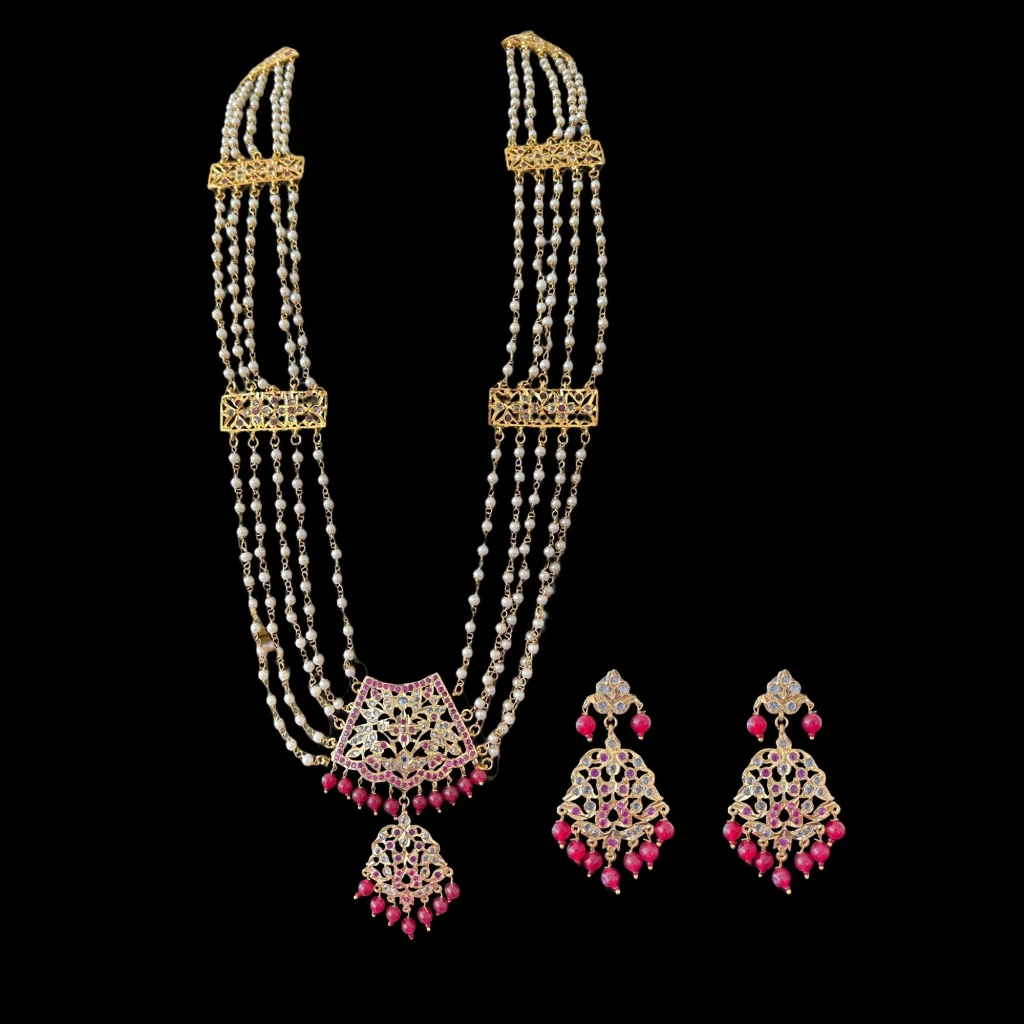
The rani haar is a statement by definition. It is long, it is layered, and it was never designed to be subtle. Worn well it is the most striking thing in the room. Worn carelessly it fights your outfit and wins.
Start with the neckline, not the necklace
This is the part that gets reversed most often. People choose the haar first and then wonder why it sits oddly. The neckline of your blouse decides what will work, and it decides it before you have looked at a single piece.
- Deep or V necklines — the most accommodating. A long haar follows the line of the opening and the two reinforce each other.
- Round or boat necks — the haar has to clear the fabric or it will bunch against it. Longer works better than shorter here.
- High or closed necks — a haar worn over fabric reads very differently than one worn against skin. It can look wonderful, but it is a deliberate choice rather than a default.
- Halter or one-shoulder — asymmetry plus a heavy symmetrical haar is a hard balance. Possible, but try it before you commit.
Layering without clutter
The classic arrangement is a choker sitting snug at the base of the throat with the rani haar falling well below it, and a clear gap of skin between the two. That gap is the whole trick. Without it the two pieces merge into a single undifferentiated mass of gold and the effect collapses.
If you are layering three pieces, make sure each length is genuinely distinct — not two that are nearly the same with one outlier. And let one piece be the loudest. Three equally elaborate necklaces do not add up to three times the impact; they add up to noise.
Balancing the rest of the face
A heavy haar pulls the eye down. If your earrings are also large and your tikka is also large, there is no rest anywhere and everything competes. Long jhumkis next to a wide multi-layer haar is the most common version of this problem — the two occupy the same space and neither wins.
A practical rule: if the haar is the star, keep the earrings closer to the ear. Studs or compact jhumkis leave room for the necklace to do its work.
Ceremony to reception
Many brides wear the fullest version for the ceremony and then strip back for the reception — the haar comes off, the choker stays, the earrings change. It is the same jewellery working harder, and it means the reception look is not simply a tired version of the ceremony look.
The reverse also works. A simpler ceremony and a dramatic reception is an entirely legitimate choice, and it has the practical advantage that you are not carrying maximum weight through the longest and most physical part of the day.
The weight is real
A substantial rani haar is heavy, and the weight lands on the back of your neck. Wear it for a while when you try it, not just for a moment in front of the mirror. If you know your hair is going up, try it with your hair up — a heavy clasp against a bare neck feels different than one cushioned by hair.
Come and try
Chura, nath, jhumkis and haars are all pieces that reward being seen in person — the weight, the drape, the way the stones catch the light. You are welcome to come try things on at either of our boutiques: Langford in Victoria, BC (250-710-4013) or Langley, BC (778-903-7979). Call ahead if you would like us to set pieces aside for you.