
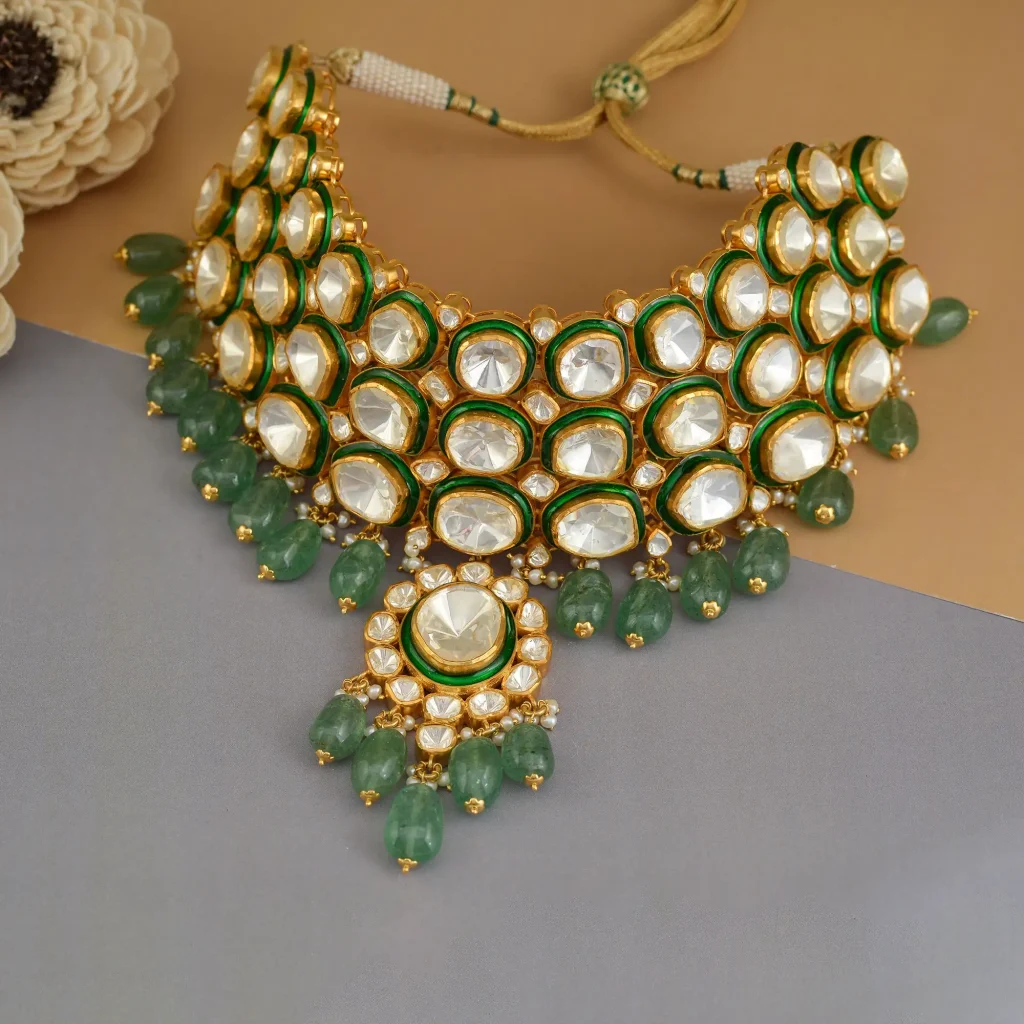
Most jewellery damage is not dramatic. It is slow, it is cumulative, and it is almost always caused by well-meant cleaning. Understanding the difference between a plain gold chain and a kundan set will save you a great deal of money and regret.
Why kundan is different
In kundan work, stones are held by highly refined gold foil pressed around them, not by claws or a bezel in the way a modern ring holds a diamond. Many pieces also use lac — a natural resin — as a base beneath the setting. That construction is what gives kundan its particular look, and it is also what makes it vulnerable.
Lac softens with heat. Foil settings lift if you work at them. Water can get behind a stone and stay there. None of this is a flaw; it is simply how the technique works, and it means kundan asks for gentler handling than a solid gold bangle does.
What to avoid
- Ultrasonic cleaners. The vibration is exactly what a foil setting cannot survive. Never put kundan or polki in one.
- Steam and hot water. Heat and lac do not get along.
- Soaking. Water trapped behind a foil-set stone will dull it from underneath and you will not be able to reach it.
- Commercial jewellery dips. Formulated for plain metal, not for foil, lac, pearls, or enamel.
- Toothpaste and baking soda. Both are abrasives. They will scratch gold, and they will do worse to a soft stone.
What to actually do
For kundan and polki, a dry, soft cloth is most of the answer. Wipe the piece gently after wearing it to lift off skin oils and any residue from perfume or makeup, and pay attention to the back of the setting where it sits against skin. If something needs more than a dry cloth, that is a conversation with a jeweller, not a project for the kitchen sink.
Plain gold with no stones is more forgiving. Warm water, a drop of mild dish soap, a soft brush, then dry it completely. Completely matters — moisture left in a clasp or a crevice is how tarnish and grime start.
Storage does more work than cleaning
The order of operations on any day you wear jewellery should be: makeup, perfume, hairspray, and then jewellery, last. Reverse that and you are spraying solvents directly onto foil settings.
Store pieces individually. Gold is soft, and jewellery jumbled together in one box scratches itself. Soft pouches or a partitioned box, each piece in its own space, away from heat and direct sunlight. If a piece came in a fitted box, that box was made for it — use it.
Take jewellery off before swimming, showering, sleeping, and anything strenuous. Chlorine is genuinely damaging, and a chura or bangle knocked against a hard edge is how stones come loose.
When to bring it in
If a stone moves when you touch it, stop wearing the piece. A loose stone is a lost stone, usually within a day or two, and refitting one is far easier than sourcing a replacement to match. The same goes for a clasp that has started to feel vague or a chain link that looks stretched.
Bring anything you are unsure about to either of our boutiques — Langford in Victoria, BC (250-710-4013) or Langley, BC (778-903-7979) — and we will take a look and tell you honestly whether it needs work.